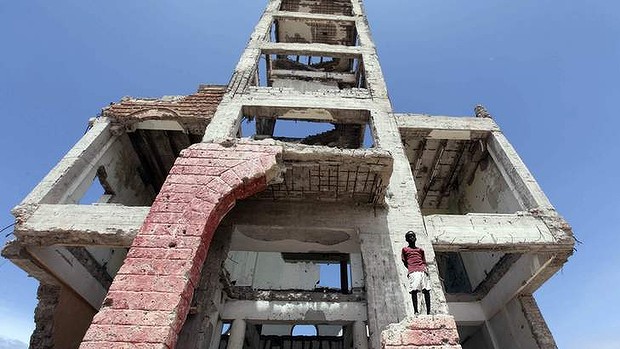
In ruins: A boy stands in the shell of the parliament building in Somalia. Photo: Reuters
Compared with the trillions of dollars flowing through the international financial system every day, the estimated $US1.3 billion ($1.46 billion) sent each year from storefronts in Somali neighbourhoods in places such as London and Minneapolis to families back home in the Horn of Africa is a droplet.
In a country where 40 per cent of the population depends on remittances from relatives abroad, however, these transactions are a lifeline. But the same money transfer services that help keep children in school and older relatives off the streets can also be used to send money to help finance groups such as al-Shabab, the feared Islamist militants who once controlled much of the country.
Humanitarian groups, politicians and Somalis are now sounding the alarm over plans by the British bank Barclays to suspend the accounts of a number of money transfer companies rather than risk a run-in with regulators over potentially abetting the financing of terrorists or money laundering.
”Millions of people depend on the remittances from outside,” said Shukri Ismail, one of the founders of Candlelight, a non-profit organisation in the northern region of Somaliland. ”If those remittances stop, it will be literally chaos.”
The looming cut-off, expected on August 10, comes as more and more Somalis have returned from abroad to invest in their home country. In June, the International Monetary Fund established relations with Somalia for the first time in more than two decades.
Mo Farah, the British Olympic gold medallist born in Somalia, has lent his celebrity to the cause, asking for a 12-month extension before the cut-off.
”Everyone following the issue understands that Barclays has a bank to run, but this decision could mean life or death to millions of Somalis,” Farah said.
If the transfer businesses are shut down, experts say, transfers will not go through other official channels but will be driven underground, making it harder to track money going to militant groups.
Barclays has come under pressure because it is one of the last banks in Britain providing services to the money transfer businesses. In December, the bank HSBC had to pay the US government a record fine of $US1.9 billion to settle charges it had worked with Saudi Arabian banks linked to terrorist organisations.
New York Times